
The associative property of multiplication for 3rd grade helps students understand that they can change the grouping of factors in an equation to make it easier to solve. This property shows that the way factors are grouped does not affect the product—it will remain the same.

What is the Associative Property of Multiplication?
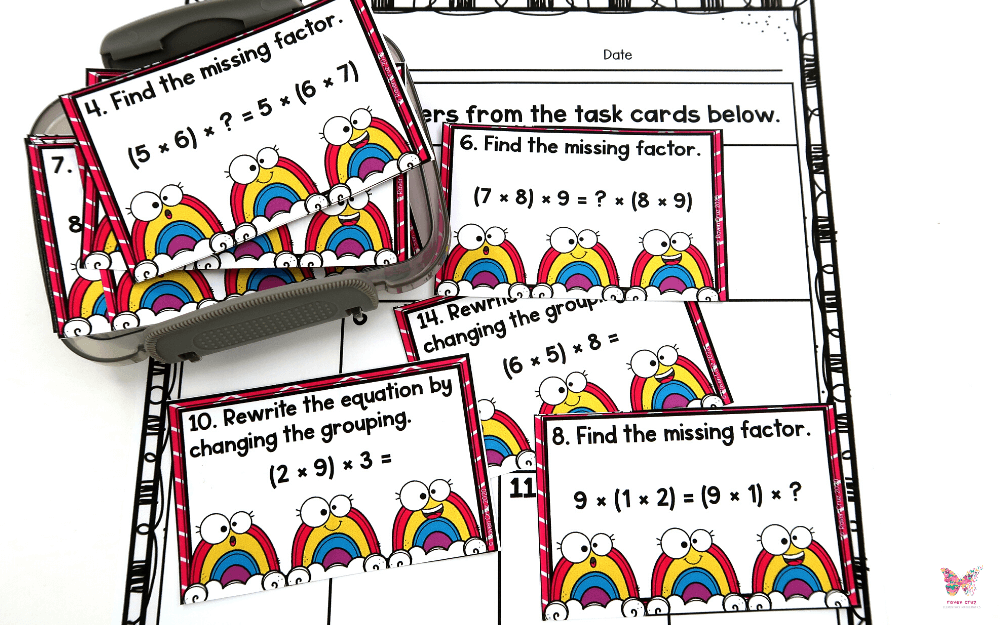
The associative property of multiplication states that the grouping of a multiplication sentence does not matter, the product will be the same. In other words, the parentheses can move to group different numbers on either side of the equation, but the numbers themselves stay in the same order, and the product remains unchanged. Take a look at the equation below.
For example:
3 × (5 × 7) = (3 × 5) × 7
Notice how the parenthesis are what changes the grouping in the equation. The product will in fact be the same, and the numbers DO NOT change places.
Explaining Associative Property of Multiplication
Also, it's important to teach your students to multiply inside the parenthesis first (PEMDAS or GEMDAS). If students have built a strong mathematical base they will not struggle when they start using algebra. This is why it is also important as math teachers to use the terms students are going to hear in algebra like equation, factor, and expression.
Expressions do not have equal (=) signs.
For example:
3 × (5 × 7)
A factor is a number when multiplied by another number it gives and expression.
3 × 5
Equations have equal (=) signs.
For example:
3 × (5 × 7) = (3 × 5) × 7
You can also use the term multiplication sentence, number sentence, and division sentence as well.
Why the Associative Property Matters
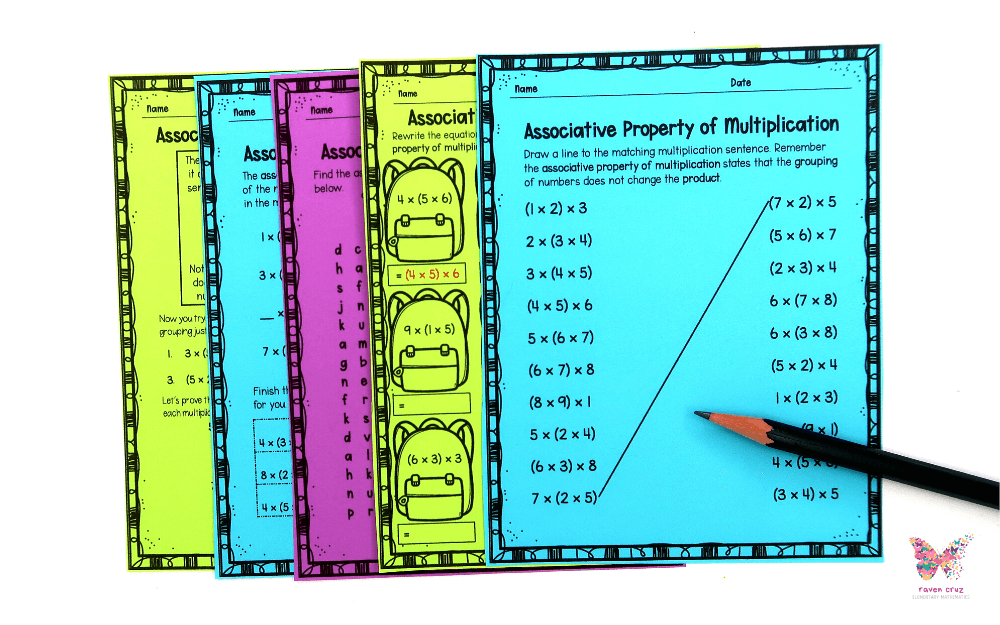
Again, the associative property of multiplication teaches 3rd-grade students that the grouping of factors in a multiplication problem doesn’t change the product. For example, in the equation (2×3)×4=2×(3×4) both groupings result in the same product, 24. This property helps students understand the flexibility of multiplication and can make solving problems more efficient by allowing them to group numbers in ways that are easier to calculate. It’s an important concept for building a strong foundation in math.
As teachers it our chance to change the negative stigma on math. I remember, after 3rd-grade I hated math. It wasn't until a college class I took at a local community college that I learned to appreciate mathematics. My teacher brought in dollar store erasers to explain a concept. She changed my life with those little erasers...

You may also like this blog post.
Teaching the properties of multiplication doesn't have to be hard!
Check out this blog post that shares fun worksheets that you can use in your 3rd-grade classroom.

SIGN UP FOR MATH WITH RAVEN NEWSLETTER
If you enjoy getting FREE quality elementary math resources + tips in your email-box, sign up for my monthly freebies and newsletter below. The freebies are EXCLUSIVE to my email subscribers.