
How to Order Numbers in 3rd Grade: Teaching Students to Arrange Numbers from Least to Greatest and Greatest to Least
Ordering numbers is an important skill that helps 3rd graders build number sense and strengthen their understanding of place value. Once students learn how to compare two numbers, they are ready to organize groups of numbers in order.
Whether students are arranging numbers from least to greatest or greatest to least, understanding place value is the key to success. In this guide, you'll learn simple strategies for teaching number order and fun activities that help students master this essential math skill.
Why Is Ordering Numbers Important?
Ordering numbers helps students recognize relationships between numbers and understand their value. This skill is used throughout elementary math and prepares students for rounding, estimation, graphing, and solving multi-step problems.
When students can confidently order numbers, they become more flexible thinkers and develop stronger number sense.
Step 1: Understand Place Value
Before students can order numbers, they need a solid understanding of place value.
Each digit has a value based on its position in the number.
For example:
| Thousands | Hundreds | Tens | Ones |
|---|---|---|---|
| 3 | 8 | 4 | 2 |
The number is 3,842.
Students should compare numbers beginning with the digit in the greatest place value.
Step 2: Compare the Numbers
Ordering numbers begins by comparing two numbers at a time.
Example:
3,842 and 3,795
- Thousands: both have 3
- Hundreds: 8 is greater than 7
Since 8 hundreds is greater than 7 hundreds:
3,842 > 3,795
Continue comparing each number until all numbers have been placed in order.
Step 3: Order Numbers from Least to Greatest
When ordering from least to greatest, begin with the smallest number and work toward the largest.
Example:
4,520 • 4,305 • 4,875 • 4,412
Compare each number using place value.
Correct order:
4,305 • 4,412 • 4,520 • 4,875
Students can think of this as counting forward.
Step 4: Order Numbers from Greatest to Least
When ordering from greatest to least, begin with the largest number and work toward the smallest.
Using the same numbers:
4,875 • 4,520 • 4,412 • 4,305
Students can think of this as counting backward.
Tips for Ordering Numbers
Teach students these simple steps:
- Look at the greatest place value first.
- Compare digits from left to right.
- Find the smallest or largest number.
- Repeat until every number has been placed in order.
- Double-check the final sequence.
Following the same process every time helps students build confidence and accuracy.
Common Mistakes Students Make
Students often:
- Compare the ones digit first instead of the thousands or hundreds place.
- Forget whether they are ordering least to greatest or greatest to least.
- Skip a number while arranging the list.
- Forget to compare all of the place values when numbers begin with the same digits.
Using place value charts and guided practice can help prevent these mistakes.
Fun Activities for Ordering Numbers
Help students practice ordering numbers with engaging classroom activities:
Roll and Order
Students roll four dice to create four-digit numbers, then arrange them from least to greatest or greatest to least.
Number Card Sort
Write numbers on index cards and have students work in pairs to place them in the correct order.
Place Value Challenge
Give students numbers with the same thousands digit so they must compare the hundreds, tens, and ones places.
Task Cards
Students compare and order groups of numbers while rotating around the classroom.
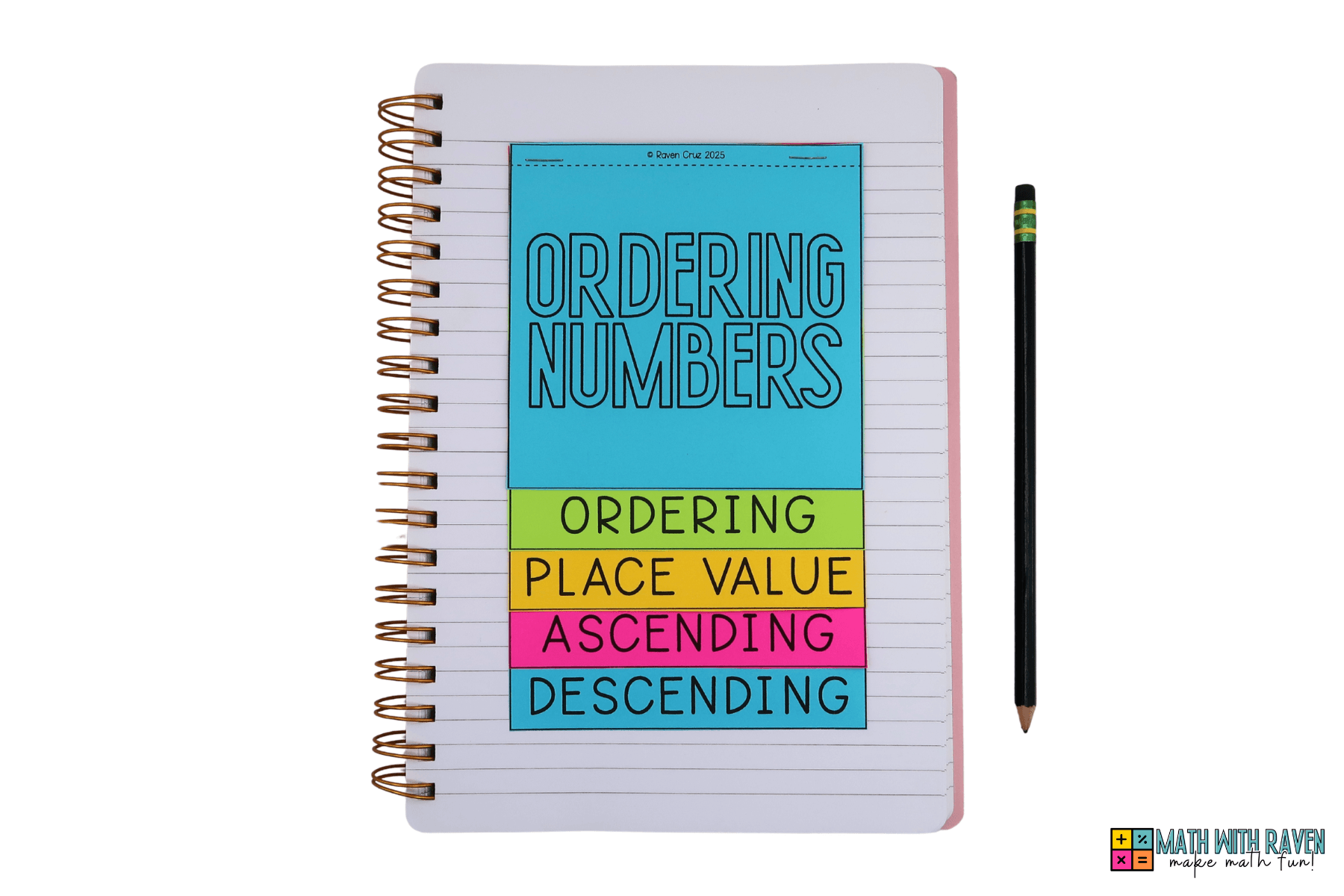
Interactive Notebook Activities
Students cut, sort, and glue numbers into the correct order while explaining their thinking.
Tips for Teaching Ordering Numbers
- Review place value before introducing ordering.
- Encourage students to explain why one number comes before another.
- Use place value charts during guided practice.
- Include both two-number comparisons and ordering several numbers.
- Mix numbers with similar digits to challenge students' thinking.
The more students practice explaining their reasoning, the stronger their understanding becomes.
Raven's Thoughts
In my opinion, ordering numbers is a natural extension of comparing numbers and an essential 3rd grade math skill. By using place value and comparing digits from left to right, students learn to confidently arrange numbers from least to greatest and greatest to least.
With hands-on activities, visual models, and consistent practice, students develop strong number sense that supports future learning in rounding, estimation, operations, and problem solving.
Free Math Resources for Elementary Teachers
Get classroom-ready math activities, teaching tips, and seasonal ideas sent straight to your inbox.
Frequently Asked Questions
How do 3rd graders order numbers?
Students compare the digits in each place value, starting with the greatest place value. They then arrange the numbers from least to greatest or greatest to least.
What is the difference between comparing and ordering numbers?
Comparing numbers involves deciding whether one number is greater than, less than, or equal to another. Ordering numbers means arranging three or more numbers in a specific sequence.
Why is place value important when ordering numbers?
Place value helps students determine the value of each digit so they can accurately compare and arrange numbers.
What are fun ways to teach ordering numbers?
Dice games, number card sorts, task cards, place value charts, interactive notebooks, and partner activities all provide engaging ways for students to practice ordering numbers.
You Can Find Me On…
I share math resources, ideas, and classroom-friendly activities in a few different places. Whether you’re looking for ready-to-use resources or inspiration, I’d love to connect!

Standards-based math resources designed for grades 2–4

Standards-based math resources designed for grades 2–4

Printable math activities and coloring pages