
What Are Lines, Line Segments, and Rays?
Lines, line segments, and rays are some of the first geometry ideas students learn. These basic concepts help students understand shapes, angles, and how figures are formed.
In this post, we’ll break down what lines, line segments, and rays are and how students can tell the difference between them.
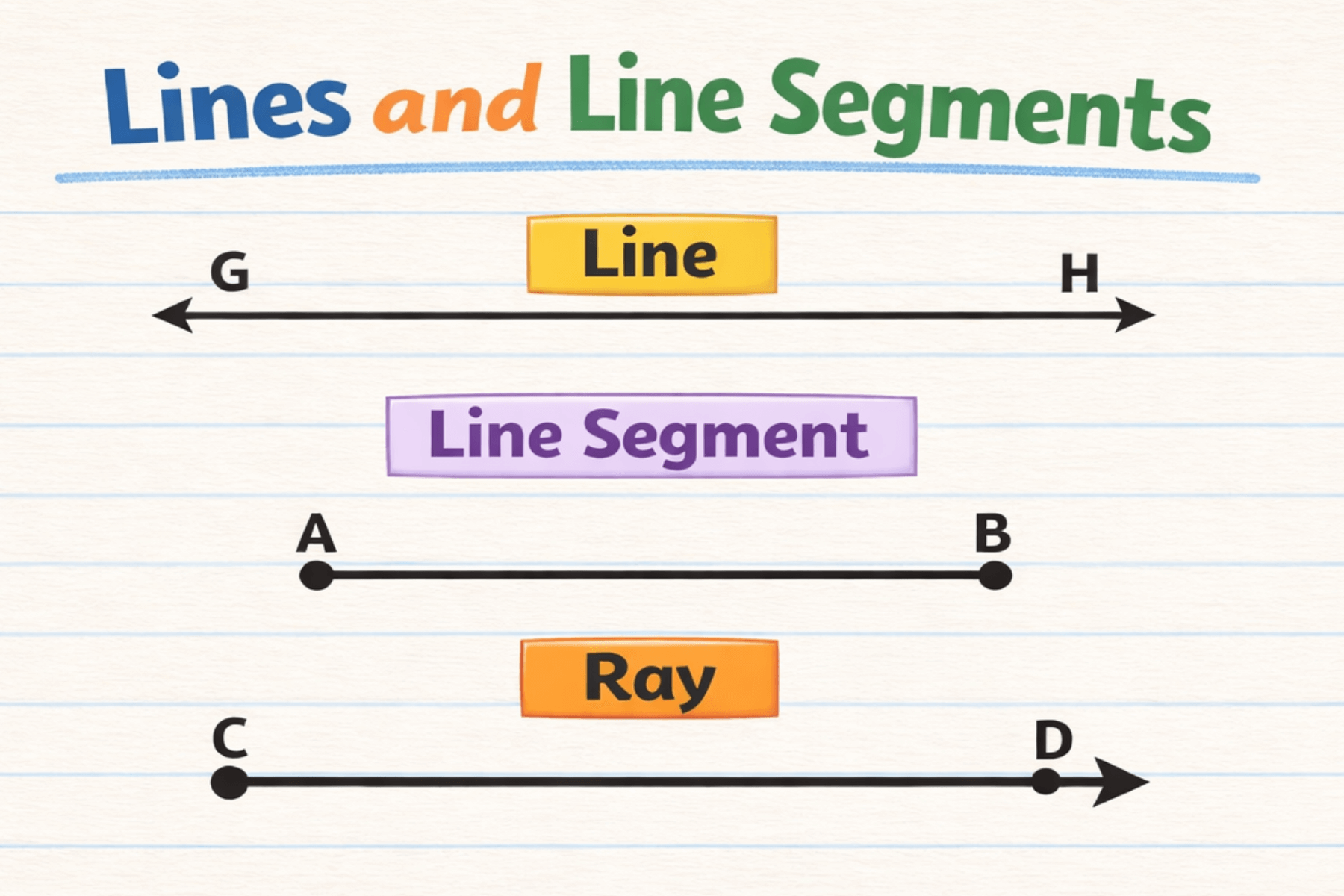
What Is a Line?
A line goes on forever in both directions.
- It has no endpoints
- It is perfectly straight
Lines are usually shown with arrows on both ends.
What Is a Line Segment?
A line segment is part of a line.
- It has two endpoints
- It does not go on forever
Line segments are often used to make shapes.
What Is a Ray?
A ray starts at one point and goes on forever in one direction.
- It has one endpoint
- It continues in one direction
Rays are often used to form angles.
Step-by-Step: How to Tell the Difference
Students can use these steps to identify each one:
Step 1: Look for endpoints.
Step 2: Count how many endpoints there are.
- No endpoints = line
- Two endpoints = line segment
- One endpoint = ray
Common Student Mistakes
Students may:
- Confuse rays and line segments
- Forget that lines go on forever
- Miss endpoints in diagrams
Using clear visuals and checking endpoints helps prevent confusion.
Using a Lines, Line Segments, and Rays Flip Book
A lines, line segments, and rays flip book helps students organize these ideas in one place. Keeping it in an interactive math notebook gives students a helpful reference during geometry lessons.
Raven's Thoughts
Understanding lines, line segments, and rays helps students build a strong foundation for geometry. These simple ideas are used again and again as students learn about angles, shapes, and polygons.
You Can Find Me On…
I share math resources, ideas, and classroom-friendly activities in a few different places. Whether you’re looking for ready-to-use resources or inspiration, I’d love to connect!

Standards-based math resources designed for grades 2–4

Standards-based math resources designed for grades 2–4

Printable math activities and coloring pages