
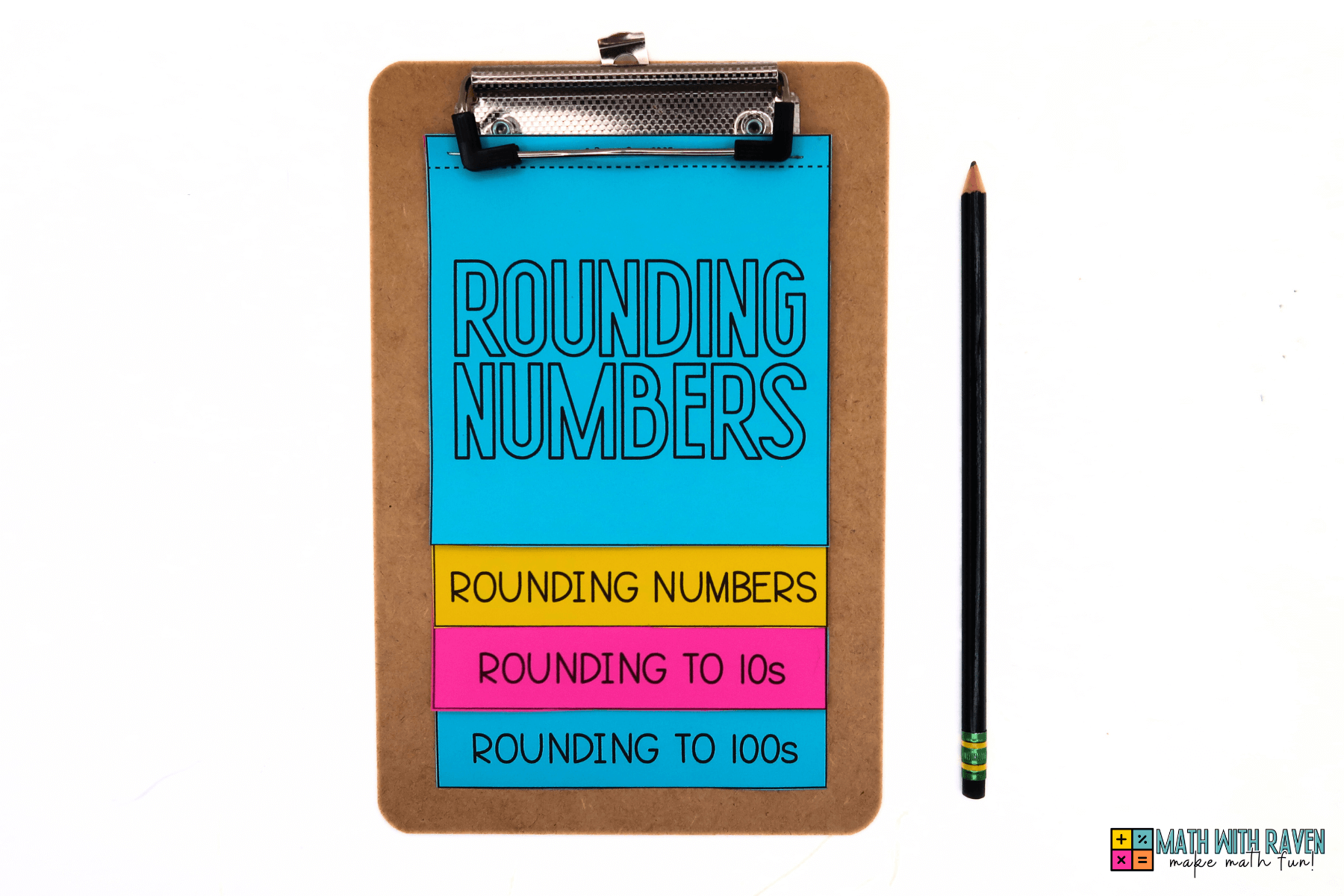
If you’re looking for how to teach rounding numbers to the nearest 10 and 100 in a way your students will actually understand, you’re in the right place. This post breaks down rounding numbers into simple steps, with helpful visuals, and provides an option for an interactive reference tool that make the concept stick.

What Is Rounding?
Rounding means finding a nearby friendly number, like a ten or a hundred - that’s close to the number you’re working with. We use rounding to make numbers easier to work with, especially when estimating or checking for reasonable answers.

The Place Value Method
This is the easiest and most reliable method for 3rd graders. It gives students a clear process they can follow every time.
Rounding to the Nearest 10
Here are helpful steps rounding to the nearest 10:
- Find the tens digit.
- Look next door at the ones digit.
- If the ones digit is 0–4, round down
→ keep the tens digit, change the ones to 0. - If the ones digit is 5–9, round up
→ add 1 to the tens digit, change the ones to 0.
Examples:
- 47 → 50 (ones is 7 → round up)
- 43 → 40 (ones is 3 → round down)
- 120 → 120 (already a multiple of 10)
Here are helpful steps rounding to the nearest 100:
- Find the hundreds digit.
- Look next door at the tens digit.
- If the tens digit is 0–4, round down
→ keep the hundreds digit; change tens and ones to 0. - If the tens digit is 5–9, round up
→ add 1 to the hundreds digit; change tens and ones to 0.
Examples:
- 268 → 300 (tens is 6 → round up)
- 241 → 200 (tens is 4 → round down)
- 700 → 700 (already a multiple of 100)
The Tie Rule
When the digit you “look next door” at is 5, you always round up.
- 150 → 200
- 350 → 400

The Number Line Method
Nearest 10 on a Number Line
- Identify the two tens the number falls between.
- Mark the halfway point (45).
- Numbers below halfway round down.
- Numbers at or above halfway round up.
Examples:
- 47 → 50
- 43 → 40
Nearest 100 on a Number Line
- Identify the two hundreds the number falls between.
- Mark the halfway point (250).
- Numbers below halfway round down.
- Numbers at or above halfway round up.
Examples:
- 268 → 300
- 241 → 200
